Adductors
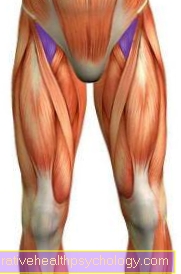
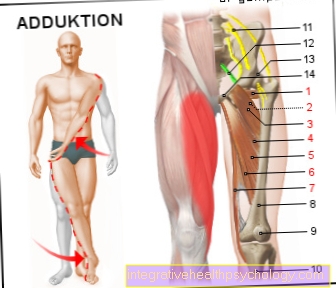
Adductors are muscles that are used to draw parts of the body to the trunk. There are adductors on the thigh, foot and hand. On the thigh, the adductors can be subdivided into three groups: superficial, medium and deep

Adductors are muscles that are used to draw parts of the body to the trunk. There are adductors on the thigh, foot and hand. On the thigh, the adductors can be subdivided into three groups: superficial, medium and deep
The arterial supply of the leg is carried by the external and internal pelvic arteries and their branches. The superficial veins run just under the skin with no accompanying arteries, while the deep veins often run like the arteries
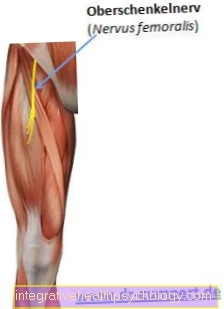
The femoral nerve belongs to the peripheral nerves and arises from the lumbosacral plexus. Its supply area is primarily the muscles of the thigh and the knee area. Therefore, it generally innervates all flexors of the hip joint
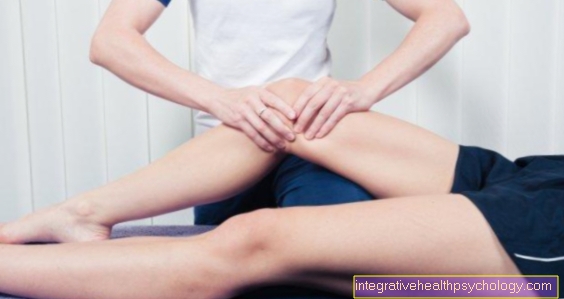
The hollow of the knee is located on the back of the knee, bounded by muscles. Important vascular and nerve structures run in it. Pain in the hollow of the knee can be caused by a thrombosis, a muscle strain, a Baker's cyst or meniscus
Pronation is the movement you make when turning your hand and forearm inward. The elbow joint, which is a hinge and ball joint at the same time, is involved in this movement and thus the crossing of ulna and
With a supination, the inwardly turned forearm is turned outward again. Thus the ulna and radius are parallel to each other and are no longer crossed.
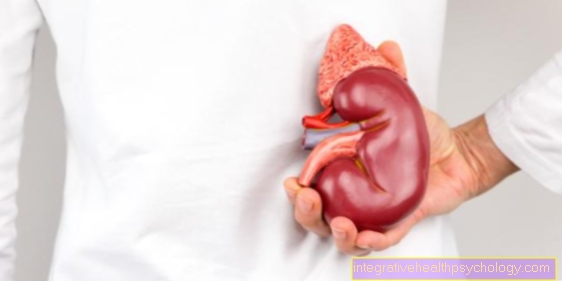
The glucocorticoids are steroids and take on so-called catabolic tasks in the body. They mobilize the resources stored in the body and can be converted into natural hormones made by the body, and into synthetic glucocorticoids that are in
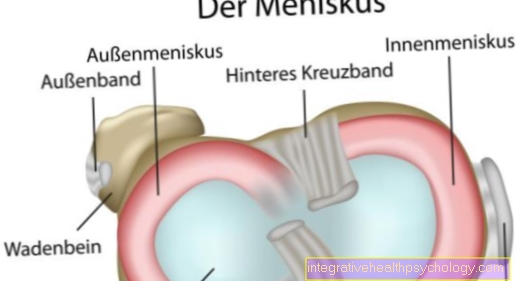
The outer meniscus is more curved than the inner meniscus. It is anchored to its anterior horn and its posterior horn in the shin bone. Because it is not fused with the collateral ligament, it is less under tension when moving and is therefore
The inner meniscus is C-shaped and larger than the outer meniscus. It is anchored in the bone at its anterior and posterior ends and fused with the joint capsule and the inner ligament. The inner meniscus is therefore much more likely to suffer from injuries
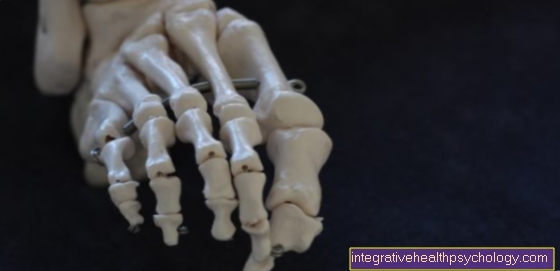
Everyone has five metatarsal joints per foot, each between the heads of the metatarsal bones and the corresponding base of the first phalanx of the toe bones. The metatarsophalangeal joints are ball joints that are secured by ligaments and thus in their
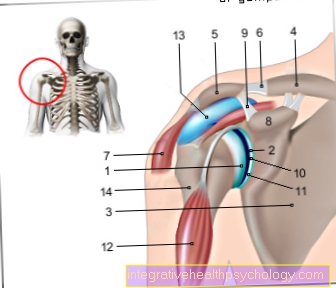
In the shoulder girdle, a distinction is made between the sternum-clavicle joint (sternoclavicular joint) and the ankle joint (acromioclavicular joint). The shoulder joint itself is not counted as part of the shoulder girdle. Belong to the bony shoulder girdle
The semimembranosus muscle (flat tendon muscle) consists of a 5 cm wide and 3 cm thick muscle belly. The semimembranosus muscle causes the lower leg to flex in the knee joint. He also works as an internal rotator of the knee joint and extensor
the medical information portal. Here you will find information on almonds that is understandable for laypeople.
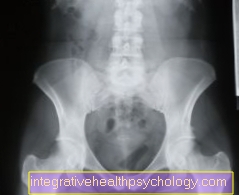
The pubic bone is a double part of the pelvis (left and right pubic bone), which is divided into a pubic body and a pubic branch. The pubic bones are connected in the middle by the pubic symphysis. They are part of the hip joint
The heart sounds arise when the heart is pumping. In the process, the four heart valves open and close, creating a sound (which is normally inaudible to us). Of the heart sounds are two in adults and up to four in children with the
The lumbar iliac muscle (M. iliopsoas) runs from the lumbar vertebrae through the pelvis to the lesser trochanter on the thigh bone, is the strongest flexor in the hip joint and therefore the strongest antagonist of the gluteal muscles. He contracts when he stands up
Blood pressure is created by the heart's pumping power, which develops a certain amount of force to allow blood to flow through the vessels. This force is also known as blood pressure and essentially depends on the performance of the heart, the physical one
As eccrine glands, sweat glands belong to the skin appendages and can be found almost everywhere on the skin. They produce sweat, which plays a central role in the heat balance and in defense against germs. In some people it occurs excessive or
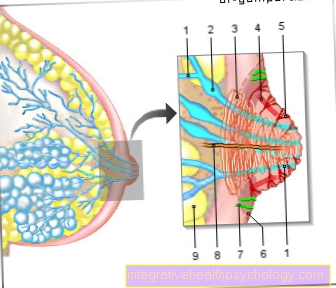
Nipples are created in pairs and are located in the middle of the breast regions in both women and men. The ducts of the mammary glands open into them, through which the woman can feed the baby with breast milk. When the man has
The hormone oxytocin is a hormone found in the posterior lobe of the pituitary gland. The hormone oxytocin, also known as the "cuddle hormone", is used, among other things, in women during or after pregnancy to prevent milk from entering and to induce labor