Triceps
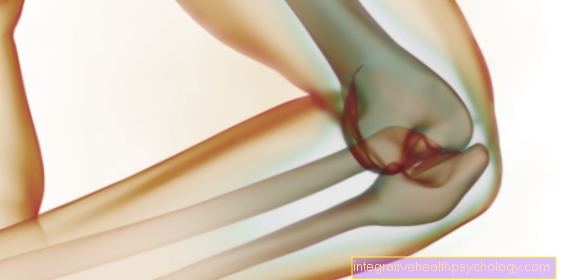
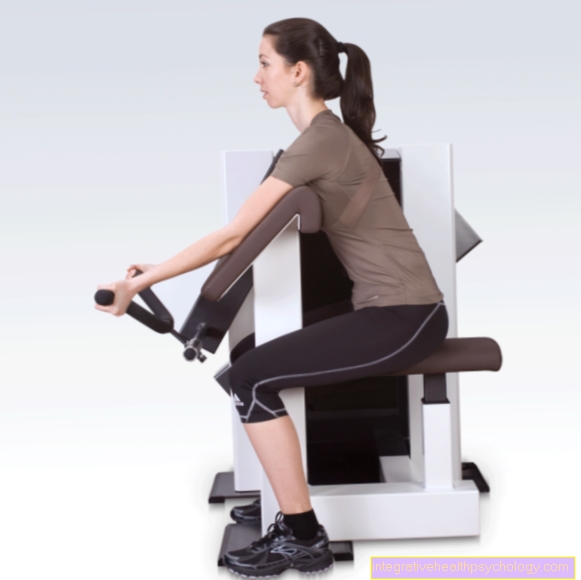
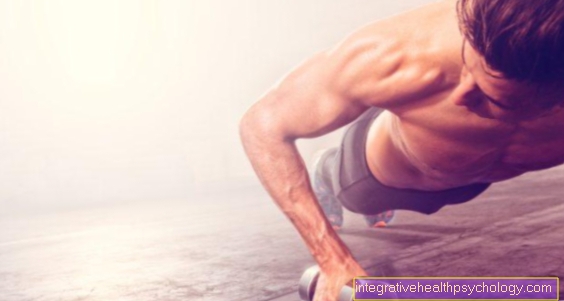
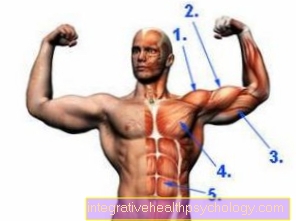
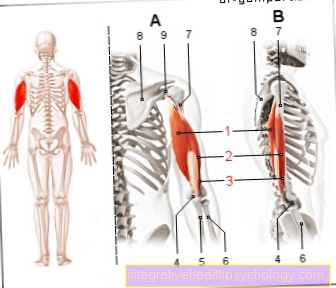
The triceps muscle (Musculus tricepstrachii) consists of three muscle heads and is important for the extension in the arm. It is often used during exercise that pushes a weight away from the body. Bench press and neck press are examples

The triceps muscle (Musculus tricepstrachii) consists of three muscle heads and is important for the extension in the arm. It is often used during exercise that pushes a weight away from the body. Bench press and neck press are examples
The synovial fluid, known in medical synovia and colloquially as "synovial fluid", is a viscous and clear fluid that is present in the joint cavities and thus also between the joint surfaces. You supplied
The inner and outer meniscus are cartilaginous structures in the knee joint that help transfer force from the thigh bone to the lower leg bone (shin). They resemble the round thighbones (femoral condyle) with the straight ones
The arm flexor (musculus brachialis) is a double-feathered, powerful flexor of the elbow joint. Due to the relatively short lever arm, the muscle is able to reach a deflection of 20 cm on the hand even if the hand is shortened by only 1 cm
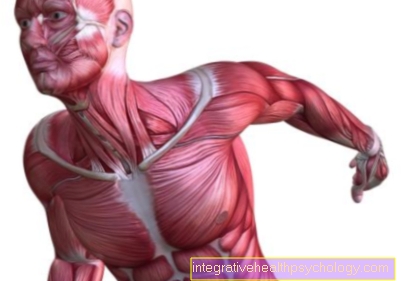
The large pectoral muscle (M. pectoralis major) arises over a large area on the chest, covers it completely and attaches to the upper arm. Its functions include adduction, anteversion and internal rotation of the upper arm. Exercising can increase its size
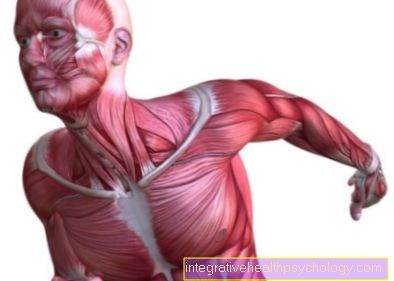
The arm muscles contain numerous muscle groups that can be painful from strains or muscle disorders. To prevent sporting problems, it is advisable to stretch your arms beforehand and to warm up the muscles. This also improves strength development
The small pectoral muscle (M. pectoralis minor) is covered by the M. pectoralis major and attaches to an extension of the shoulder blade. It pulls the shoulder blade forward and down when contracted. It can also act as an auxiliary breathing muscle when you have your arms
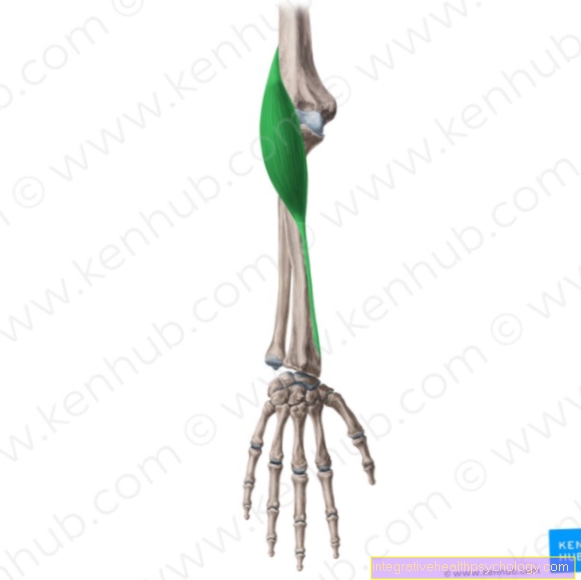
The upper arm spoke muscle (musculus brachioradialis) is a powerful flexor of the elbow joint. Its slim muscle belly runs along the middle of the forearm and forms the anatomical boundary between the flexor and extensor muscles of the forearm
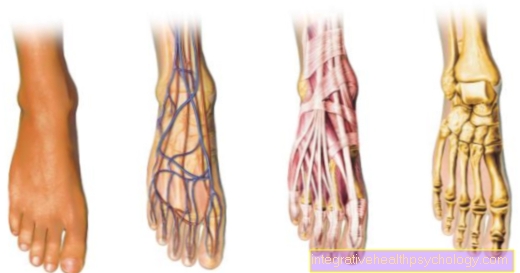
The seven tarsal bones can be divided into a row close to the body and a row remote from the body. The tarsal bones near the ankle include the talus and heel bone. In the direction of the toes are the five distant bones of the navicular bone, three
Metatarsals are also called metatarsals and each consist of a base, a corpus (middle section) and a caput (head). Hallux valgus (hammer toe) is an important and well-known disease that involves the metatarsus. Furthermore come
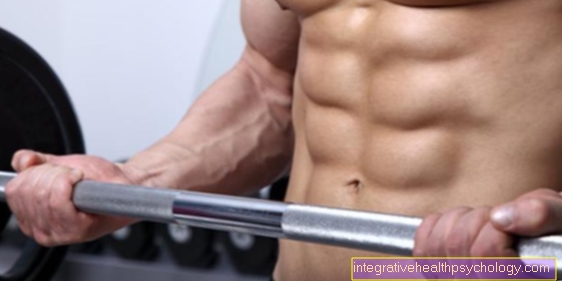
The abdominal muscles represent the opponent to the back muscles and are important for prevention. There are numerous exercises to train different muscle groups. However, overuse can also lead to injuries
The chest muscles (M. pectoralis major and minor) originate in the chest and attach to the upper arm, so its contraction causes adduction, anteversion and internal rotation in the upper arm. Often its enlargement and refinement of the contours is sought
The back muscles consist of different muscle groups. A distinction is made between the autochthonous back muscles, which are placed directly on the spine, and secondary back muscles that have immigrated. The main function is to stabilize the vertebrae
The lower leg muscles can be divided into flexors and extensors, with the flexors at the back and the extensors at the front. Varicose veins are often visible on the back of the lower leg because of the blood
The connective tissue has many different functions and tasks in the human body. The structure of the connective tissue comprises a multitude of components and changes can lead to functional losses or diseases.
Tendon sheaths are connective tissue "tunnels" that surround the tendons of muscles at certain points in the body to protect them from mechanical irritation. This is especially necessary where tendons border on joints. Painful inflammation develops
Since the biceps has two sinewy origins, a distinction is made between the long and the short biceps tendon. The tendons are often torn off, leading to painful restriction of movement and loss of strength. For muscular complaints
An elevated diaphragm occurs when the abdominal organs under the diaphragm are abnormally enlarged. The diaphragm is also pushed up during pregnancy. Breathing can be restricted, causing shortness of breath and a feeling of pressure on the costal arch
The Achilles tendon is the terminal tendon of the three-muscle triceps surae on the lower leg. It starts at the heel bone and is involved, for example, in being able to stand on your toes. The triggering of the Achilles tendon reflex belongs to
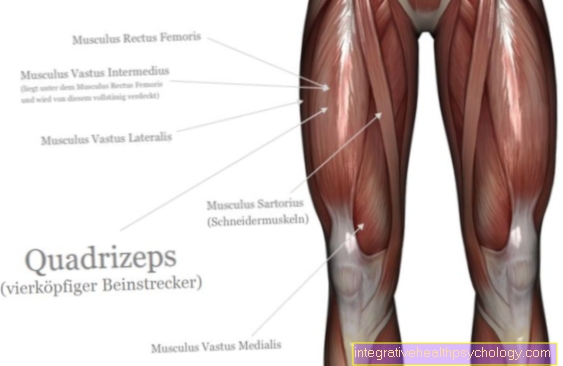
The four-headed thigh muscle (M. quadriceps femoris) consists of four larger units and covers the entire thigh from the front. It starts on the lower leg via the kneecap and its most important functions are flexion in the hip joint